
Mid-to-late fall, after the leaves drop, is a good time for corrective pruning. With branches bare, you can see a plant’s structure and spot problems easily. Good pruning in a tree’s or shrub’s early years prevents many problems later.
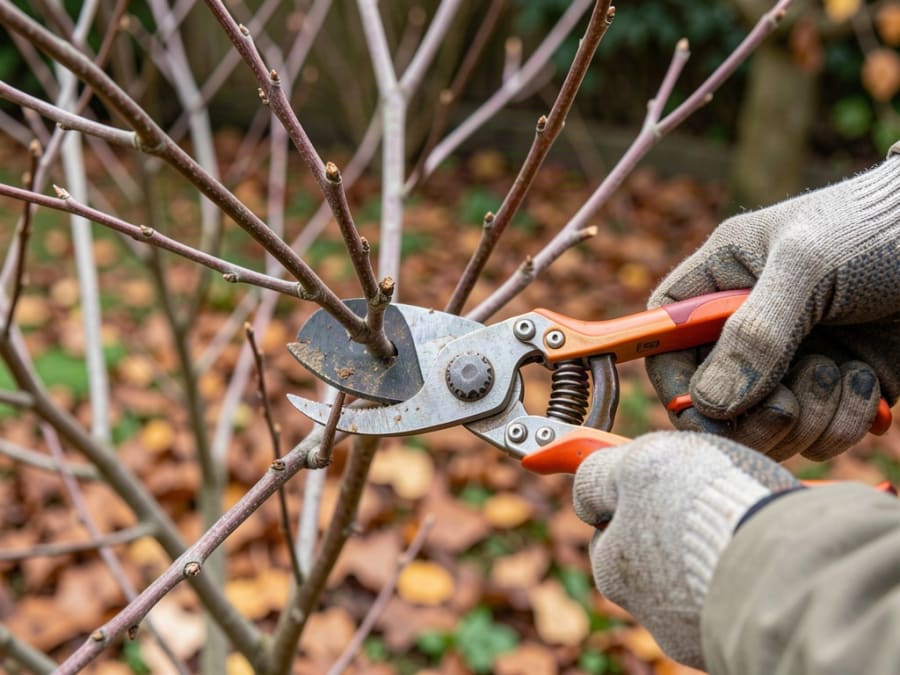
What to prune in fall
- Dead, diseased or broken branches. These can be removed any time of year. Cut back to healthy wood.
- Crossing or rubbing branches. Rubbing wears through bark and opens wounds. Remove the weaker of the two.
- Suckers and water sprouts from the base or trunk.
- Structural pruning on young trees: choose one central leader, and remove competing leaders and narrow, V-shaped branch angles.
- Summer-flowering shrubs that bloom on new wood, such as panicle and smooth hydrangeas, butterfly bush, spirea and potentilla, can be cut back after they go dormant or in late winter.
What not to prune in fall
- Spring-flowering shrubs and trees such as azaleas, rhododendrons, lilac, forsythia, flowering dogwood, flowering cherry and bigleaf hydrangea. They’ve already set next spring’s flower buds. Prune them right after they bloom instead.
- Heavy pruning in early fall. Big cuts in September can trigger tender new growth that won’t harden off before frost. Wait until plants are fully dormant.
- Newly planted trees beyond removing damaged branches. They need their leaves next spring to feed new roots.
- Oaks in regions with oak wilt: follow local timing guidance, typically pruning only in the dormant season.
How to make a good cut
- Use sharp, clean tools: bypass pruners for stems up to about ¾ inch, loppers for larger ones, and a pruning saw beyond that.
- Cut just outside the branch collar, the slightly swollen ring where a branch meets the trunk. Don’t cut flush, and don’t leave a stub.
- For heavy limbs, use the three-cut method: an undercut, then a top cut farther out to drop the limb, then a final cut at the collar. This prevents bark from tearing down the trunk.
- Skip wound paint. Trees seal wounds on their own. Dressings don’t help and can trap moisture.
- Don’t overdo it. Remove no more than about a quarter of a plant’s live canopy in one year.
Large trees? For work above the ground or near power lines, hire an ISA Certified Arborist. You can find one near you.
Shopping for shrubs that need little pruning? Ask the growers at Means Nursery about compact varieties sized for your space.